
Celestial Gallery
Sagittarius A*: The Supermassive Black Hole at the Center of the Milky Way
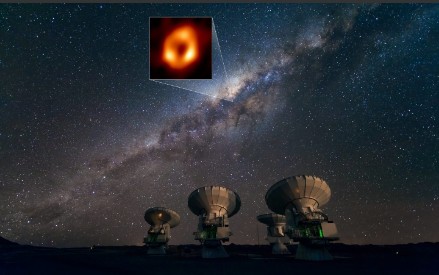
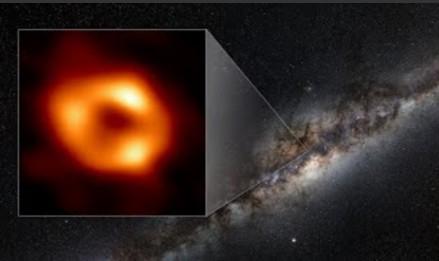
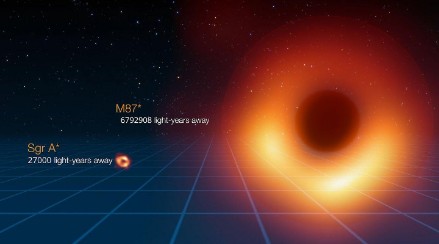
Sagittarius A* (abbreviated as Sgr A*) is a supermassive black hole located at the center of the Milky Way Galaxy, approximately 26,000 light-years from Earth.
It possesses a mass nearly 4 million times greater than the Sun and is concentrated within a very compact region of space. Due to its proximity compared with other galactic black holes, Sagittarius A* serves as one of the most important natural laboratories for studying General Relativity, gravity, and black hole physics.
More information: NASA Sagittarius A*
Discovery and Evidence
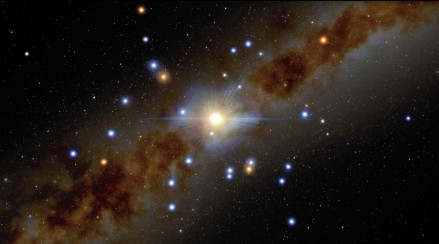
The existence of Sagittarius A* was first inferred through powerful radio emissions originating from the galactic center.
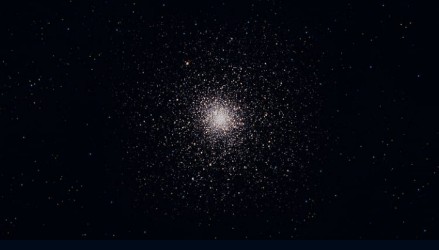
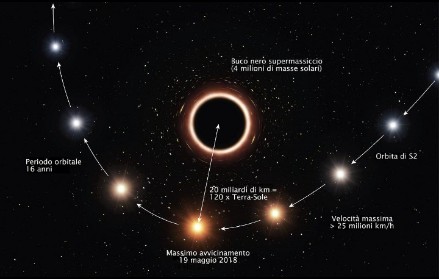
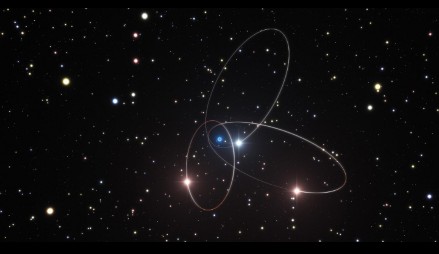
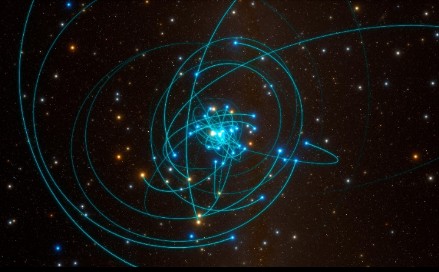
Later, astronomers carefully tracked stars orbiting an invisible object. One of the most famous stars, S2, moves at extremely high velocities and completes an orbit in nearly 16 years.
These observations provided direct evidence that an enormous amount of mass was confined to a very tiny region, strongly supporting the existence of a supermassive black hole.
Reference: Event Horizon Telescope Collaboration
Event Horizon and Spacetime
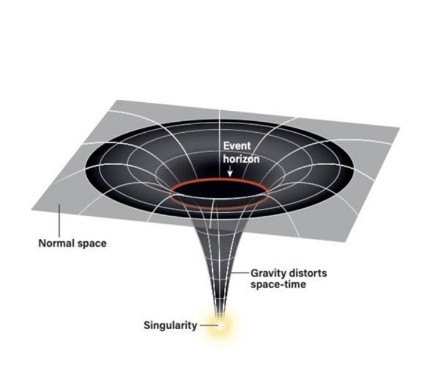
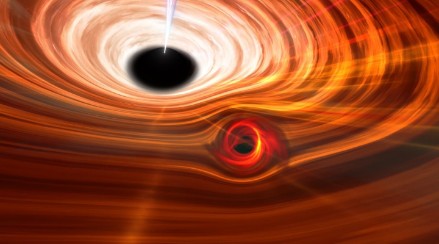
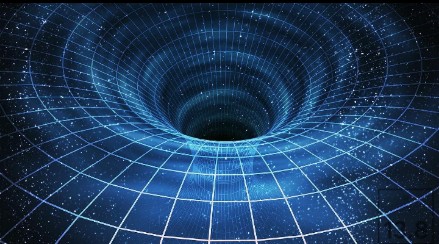
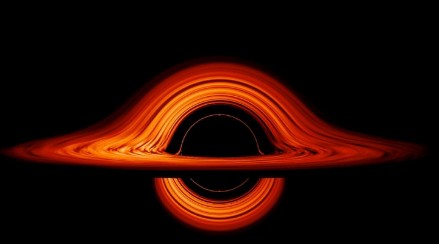
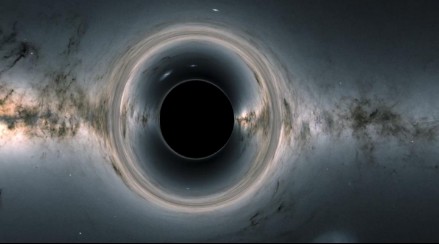
The most important feature of Sagittarius A* is its event horizon, a boundary beyond which no matter, radiation, or information can escape.
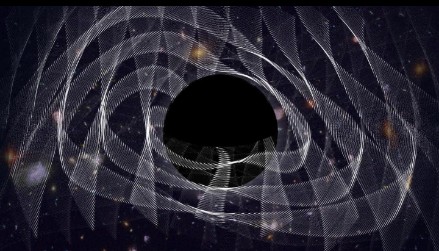
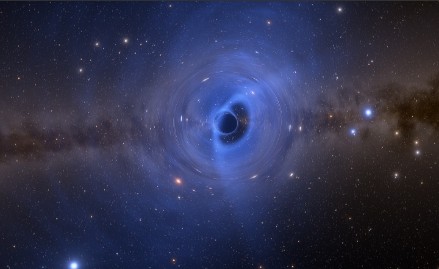
Near the event horizon, gravity becomes extraordinarily intense, causing severe curvature of spacetime.
- Schwarzschild radius: ~12 million km
- Escape velocity: exceeds the speed of light at the horizon
- Time dilation: time slows dramatically near the black hole
These phenomena are predicted by Einstein’s General Relativity.
Accretion and Radiation
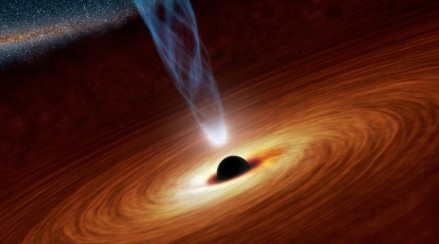
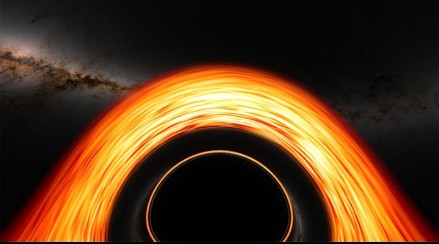
Matter approaching Sagittarius A* forms an accretion disk, where gas and plasma rotate at extremely high velocities.
Friction and compression heat the material to millions of degrees, generating X-rays, radio waves, and infrared radiation.
Unlike highly active galactic nuclei, Sagittarius A* currently exhibits a relatively low accretion rate, making it comparatively quiet.
Direct Imaging (Event Horizon Telescope)

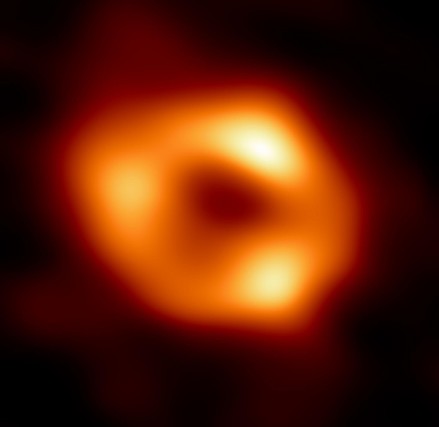
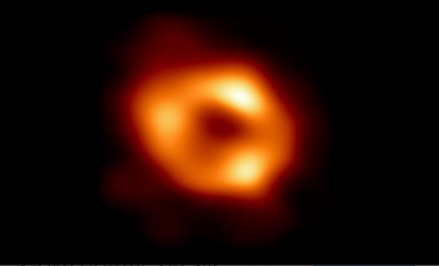
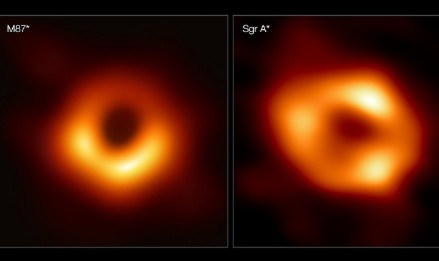
In 2022, the Event Horizon Telescope (EHT) collaboration released the first direct image of Sagittarius A*.
The image revealed a glowing ring of hot plasma surrounding a dark central shadow produced by the black hole’s gravity.
This observation strongly confirmed theoretical predictions of black hole physics and General Relativity.
Scientific Importance
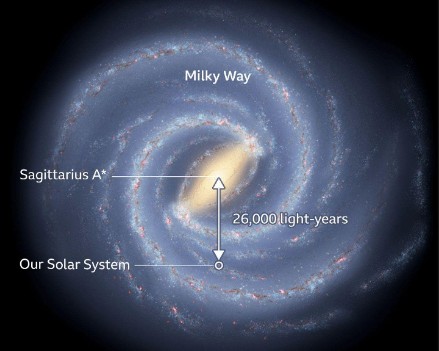

Sagittarius A* plays a central role in understanding galaxy evolution, black hole growth, and extreme gravitational environments.
Its interaction with nearby stars and gas clouds influences the structure and dynamics of the Milky Way’s core.
Historical and Scientific Impact
- Direct evidence for supermassive black holes
- Precision tests of General Relativity
- Understanding galactic center dynamics
- First direct image of the Milky Way’s central black hole
- Major advancement in Astrophysics